
Psalm 7 Part 3 - Conclusion
Finding Rest in A Hurried World

Introduction
This is the third and final post on Psalm 7. One of many things I hope you’ve received so far is that there are several ways you may approach the scriptures. Initially, you always want to approach them within the context in which they were written because context is king. So, you always look at the immediate meaning of what’s going on and I explained that in the first post dedicated to Psalm 7.
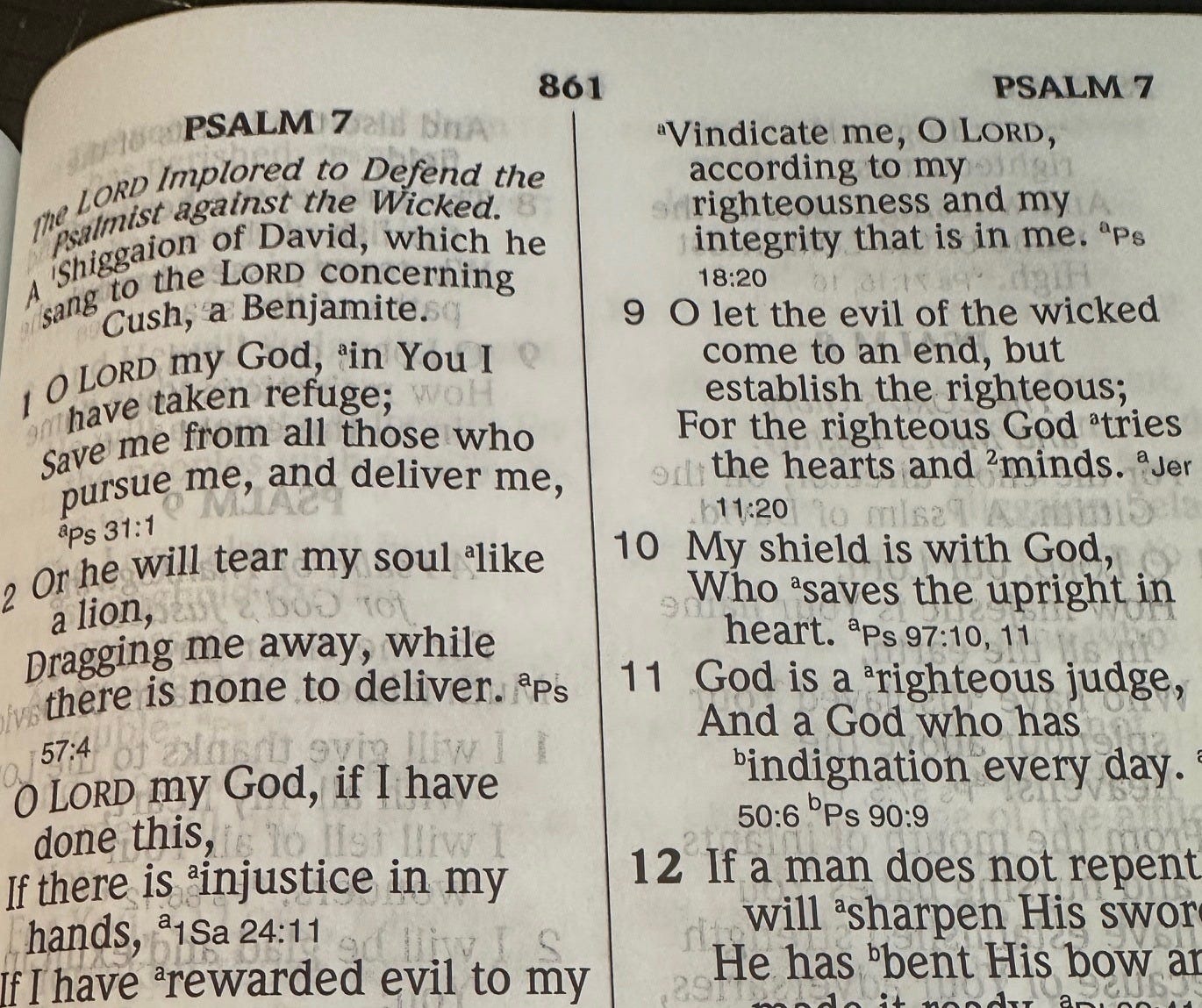
The context here—we see it in the preamble to the psalm, where it says, “A Shiggaion of David, which he sang to the Lord concerning Cush, a Benjaminite.” The context is slander, gossip, ridicule, and being verbally attacked—those kinds of things. And David is praying. In fact, he is singing unto the Lord. That’s what that word there, Shiggaion, means: it means a song of life, a song sung with high notes and low notes. And I think that describes life, doesn’t it? Because sometimes there are highs, and other times there are lows, and we strive to have a balanced life, don’t we? But that’s not always the case, and things happen. And so sometimes we find our lives going somewhat like this. So that’s what we see here in this Psalm 7.
God Is Sovereign, So We Can Rest In Him
This Psalm gives us a picture—and I told you I had eight points. We covered three of them in the previous post. But I’ve taken the approach that this gives us a picture of godliness; it gives us a picture of how we are to live or rest, understanding that God is sovereign. Now, that’s one of those great doctrines of Christianity that we really benefit by understanding as fully as we can. Because there are some things concerning God’s sovereignty, and let’s just face it, we have disagreements on. There are people much wiser than I, much more studied than I, who disagree with one another on this topic of God’s sovereignty: how far-reaching is it? How encompassing is it? What is the depth of it? Well, you’ll pick up on some of that today in this post.
But this idea of godliness, resting in a hurried—how many of you—is anybody not living a life that just seems to be going 90 miles an hour, 24/7? Or is it just me? Listen, if you’ve learned how to escape that vicious, vicious cycle, I’d like to talk to you, because maybe you have some pointers for me. I think it characterizes life today, especially life in America. It just seems like that’s how it is. And that’s not a criticism; it’s just an observation. And if that is how it is, then what do we need to be able to live in that context? Because it doesn’t do any good to say, “Well, I hate this. I hate it, I hate it, I hate it.” You’re still in it. You’ve got to learn to cope with it, or better yet, overcome it.
So how do we do that? And that’s what I’m pulling out of here and sharing with you today. Now, let me give you these first three points as we get started. I covered these in the last post, so I don’t want to spend a lot of time on them again.
Three Points To Consider
Verse 1 Notice it says, “O Lord my God.” David is calling out, or appealing, to a covenant God—a relational God. He is saying God desires to have a relationship with us. Now, if you want to strip the gears of your brain sometime, try to figure that out: why the Creator of the universe would care to have a personal, one-on-one relationship with you. I’ve thought about that a lot in the 42 years I’ve been a believer, and I still marvel at why God cares about me. And I know part of it is because I understand what a wretch I am. I understand who I am in all my frailties, and all my faults, and all my warts, and yet God loves me anyway. Now, that is a mystery to me. A mystery in the sense that I don’t understand it. I know what the Scripture says, and I am so thankful for that assurance that He loves me, but it is a mystery.
So, in this first verse, I find point number one for us. David says, “O Lord my God, in you I have taken refuge; save me from all those who pursue me, and deliver me.” So, point number one, folks, is that the believer, the Christian man or woman, recognizes that he needs help to live his life for the glory of God. He can’t do it by himself. There’s no such thing as Lone Ranger Christians. Those who think they can do it by themselves—I’m telling you right now, maybe it’s been your experience because you’ve tried it, but I’m telling you, if you try to do it on your own, you are going to fail. You just are.
Some of you may know that from experience. That hurts, doesn’t it? When you kick your foot against the rock or run your head against the wall, that hurts. And you would think after once or twice of doing that, we wouldn’t do it anymore. But it seems like we still do it again and again and again. We need God, brothers and sisters, to live this life for His glory.
Now, just as soon as you determine that you’re going to live your life for His glory, I’m guaranteeing you—and it’s not that I’m a prophet, although I do believe I have the modern-day New Testament gift of prophecy, which is teaching—I’m not a prophet, but I’m guaranteeing you, brothers and sisters, the day that you determine, vow in your heart before the Lord, that “I am going to do things Your way,” the world is going to come against you. They will. Because when they catch a glimpse of a righteous man or woman trying to live their life for the glory of God, you will experience opposition. It’s just a matter of when, not if.
So, we must learn how to handle what the world throws at us, right? We must learn how to handle it. And I think that’s one of the secrets that Paul was trying to explain to us in the book of Philippians. You can read that on your own for a devotional; chapters 3 and 4 would be good in this present context. In fact, chapter 3 is the context of what he says in chapter 4, verse 13, “I can do all things through Christ who strengthens me.” We misapply that scripture sometimes, but if you read chapter three, you’ll see the context, and I’ll leave you to do that on your own.
We see another point, though, in verse one—the second point that I gave you in the last post—and that’s this: the believer, the Christian man or woman, takes refuge in God before trouble happens. Notice that he says here, “O Lord my God, in you I have taken—I have taken…” So that answers some questions for us, doesn’t it? Why does trouble happen in believers’ lives? Well, because it happens to everybody; we’re not immune to that. But why does trouble seem to camp out in some believers’ lives? Well, here’s my theory—you may have a different one, but think about this: I think it’s because they’re not taking refuge in God. Oh, they’re going through all the motions, they’re saying all the right things, doing some of the right things, but really deep down, they’re far, far away from God. They’re not living under the shadow of God’s wings.
And when trouble comes, what happens to that believer who has not taken refuge under the Lord? They’re shipwrecked. They’re shipwrecked. And then, arrogantly, “Oh God, why has this happened to me?” What are you talking about? You haven’t walked with me for a good long time, and now you’re asking why this is happening to you? Isn’t it obvious?
So, we take refuge in God before trouble happens. And we can do that when we recognize what it means to be in Christ, because that’s what David has said here in verse one: “O Lord my God, in you—in you I have taken refuge.” What does it mean for New Testament Christians to be in Christ? I gave you several things in the last post; I’m not going to rehash them again, other than just mentioning them. We are chosen in Christ (Ephesians 1:3-4), we are redeemed in Christ (Matthew 1:21), we are regenerated (Titus 3:5), we are justified (Philippians 3:9), we are sanctified (1 Corinthians 6:11). We are raised with Christ—already but not yet. We live in the Kingdom now, but the Kingdom to come (1 John 3:2). So we have all of those things as a benefit to us.
Now, one other thing I want you to see here in these first couple of verses is this: the believer’s integrity and the believer’s innocence have nothing whatsoever to do with the trials that may come their way. Because here’s what I do know: liars, thieves, and sinners will always, always come to the most heavily laden tree—the most heavily fruit-laden tree—to steal, kill, and destroy. So don’t equate troubles that you may be going through necessarily with the fact that you’ve gotten off course. Maybe it’s because you are walking by the Spirit and you’ve become a target for evil.
Proverbs 3:5-6 says that we are to trust in the Lord with all of our heart and not lean on our own understanding. If we do that, in all our ways acknowledge Him, He will make our path straight, it says.
Third point from the last post is this: the believer, the Christian man or woman, takes a right assessment of every situation—takes a right assessment of every situation. No sugar-coating, no bargaining with God.
Where do you see that, Mike? Well, that’s verses one and two combined. “O Lord my God, in you I have taken refuge; save me from all those who pursue me and deliver me. Verse 2: or he (referring back to all those who pursue me) or he will tear my soul like a lion, dragging me away while there is none to deliver.” Sometimes, we don’t take an accurate evaluation of a situation. We don’t see the danger we’re in. We think we can handle it; we think we can deal with this. Or we think, “Well, God certainly wouldn’t allow trouble in my life. He certainly wouldn’t allow a shipwreck; He’s going to save me before I lose this or lose this, or my marriage goes to the rocks, or I lose all my money.” Well, not necessarily. Not necessarily. It’s going to depend on your response to God’s will and calling.
You see, the Holy Spirit is going to speak to us in the midst of our trials and struggles, and whether or not we listen to Him is going to determine a number of things. One: how long we stay in the fire. Number two: the extent of the consequences. I could point to you—I didn’t jot any down—but I could point to you a long list of people who, by the world’s standards, had it all as a believer and then left the reservation, got off the railroad tracks, and they ended up poor, homeless, nearly destitute. Now, I know that flies in the face of some theology out there that says God would never let you go there. Experience says otherwise. The truth is that we can toss away all of God’s blessings in our lives by the way we live.
So the godly believer, the Christian man or woman, takes a right assessment. No sugar-coating, no bargaining with God.
Points Four Through Eight - Honest Self-Evaluation Is Key
Here’s your fourth point: The Christian—the believer, the man or the woman who trusts in Christ—examines himself honestly. Verses 3 and 4: “O Lord my God, if I have done this, if there is injustice in my hands, if I have rewarded evil to my friend or have plundered him who without cause was my adversary…” So, take an examination of your life.
Now, what does this say to us? This says to us, brothers and sisters, that there is no room for justifying our behavior when it’s contrary to the scriptures. Now, why would that need to be said? Because we do, don’t we? We do. We do not like being under the glaring light of God’s holiness and righteousness that says, “You are wrong.” Man, we run from that like a cockroach when the light is turned on.
But here we see David crying out to the Lord, “If I have done this thing, if there is injustice in my hands, if I have rewarded evil to my friend or have plundered him without cause who was my adversary…” He’s taking an evaluation of himself honestly.
And then look at verse 5, the fifth point here: The godly man doesn’t stop right there. How many of you know that you can deceive yourself? Verses 3 and 4, it seems that David is opening himself wide up, and he is to his own evaluation. “Lord, if I am doing this, if I’m doing this, if I’m…” So he’s evaluating himself. But this point here, look at verse 5: “Let the enemy pursue my soul and overtake it, and let him trample my life down to the ground and lay my glory in the dust.”
So, if verses 3 and 4: “If I’ve done this, if there’s injustice, if I’ve rewarded evil, or if I’ve plundered without cause, let the enemy pursue my soul and overtake it, and let him trample my life down to the ground and lay my glory in the dust.” What’s David saying here? He’s saying, “I’m evaluating myself, Lord, but I know I can deceive myself.”
We’re blind to many things about ourselves, brothers and sisters, and we don’t want to admit them, and we will not admit them. But David goes a step further. He recognizes his own weakness and his own flesh, and he says, “Lord, it’s not enough for me to examine myself and say, ‘Oh, I’m innocent.’ I want you to examine me, and You declare that I’m innocent.” See, that’s the fifth point: the godly man asks God to examine him so that no self-deception keeps him from deliverance.
You wonder why you’re in the fire sometimes, and God’s not answering your prayer and not delivering you from the fire, because you’re deceived. You’re excusing your behavior. It’s an easy answer, but it’s hard to arrive at.
So David says, “God, You examine me. You tell me what’s going on because I can’t trust myself.” Wow. Wow. That’s a good step in the right direction, isn’t it?
And then, a sixth point: the believer, the Christian man or woman, once he evaluates or she evaluates herself, asks God to evaluate. And what’s going to happen, brothers and sisters, what’s going to happen when you ask God to evaluate you? Well, first of all, let me back up. How much courage does it take for you to ask God to evaluate you? How many of you know God doesn’t play? How many of you understand that God will give you the straight scoop? So, it takes a lot of courage to do that, first of all.
But when we do that, brothers and sisters, God will give us a very clear picture of where we’re at. Now, what is the purpose of that? The purpose of that is for deliverance, isn’t it? We cry out, and we want to be delivered from something, some kind of oppression, or some kind of evil. And we cry out, and if we do that, and we ask God to give us clarity of understanding, and if there be anything in us, to point it out—He will do that. He will do that. And then, you are delivered. Once you are delivered, you can see straight then, and you can see clearly.
And that gives us a seventh point, in verses 6 and 7, and it’s this: the believer, the man or woman who desires to live a godly life, asks God to act against injustice and recognizes that God’s judgment is an outpouring of His holiness. Look at this: verses 6 and 7. So, after examining himself and asking God to examine him, David says in verse 6, “Arise, O Lord, in Your anger.” We don’t read that much in the New Testament, do we? But David says, “God, arise in Your anger.”
Now, what does that mean? Well, it’s in a context. So, notice: “Lift up Yourself against the rage of my adversaries.” In other words, against their behavior, God—in Your anger, in Your holiness—that’s what he’s referring to. In Your holy judgment, God, rise up. Lift Yourself up against the rage of my adversaries—in other words, against their behavior—and arouse Yourself for me. You have appointed judgment.
I think it would be good for churches to teach through the Old Testament because you see things just like this. Churches that only focus on the New Testament, one of the things that they’ve excluded from a correct teaching about God is judgment. They’ve completely whitewashed judgment out of the picture.
Now, I’ve got to tell you something, brothers and sisters, judgment’s coming. My personal opinion is that judgment has already arrived in America. We’re already under the hand of God’s judgment. Well, how do you know that? Open your eyes. And it’s only going to get worse, by the way. My personal view is—you may hold a different view, and that’s okay—but my personal view is America is on the decline. We’re not plateaued; we’re definitely not on the ascendancy. We are in decline.
Now, we could argue about how steep that decline is. Are we in a free fall? All I know is that the only thing that will save us is if we have a nationwide outbreak of repentance. Some of you who have been here at Calvary Chapel of Lima for a while, you know what my view is on that—that isn’t going to happen. I don’t see it. I think the Scripture is clear. It gives us a picture of the end times being a time of apostasy, not revival.
Now, there will be a great revival in the end times. It’s going to be after the rapture of the church when there’s 144,000 Jewish evangelists out sharing the gospel. It will be a great revival, but salvation at that point will likely cost people their lives because they will be living under the rule of the Antichrist.
Be that as it may, I think the church would be much better off if we would teach the Old Testament today, too, because you see these kinds of pictures: that God rises up in His holy anger to judge evil and sin. You don’t hear about that much in churches today.
David is calling on God to judge injustice, to act against that. David recognizes that God is a God of judgment. That’s a good note for us to keep in mind. Notice verse 7: “Let the assembly of the peoples encompass You.” Doesn’t that give you the picture of a trial? The court? God is holding court, calling all the peoples together.
Now, if it’s a picture of heaven, then all these people here, the people that encompass God around the throne, that’s you and me. That’s you and me, believers. David says, “And over them return on high,” so have authority, have dominion, have rule. That’s a beautiful picture.
In the next section, point eight, we’ll unpack this slowly because it traverses verses 8 through 16—almost all of what is left. Now, let’s read it together first, and then we’ll go back. But here’s the point. Let me give you the point first—point eight of eight.
The eighth point is this: the godly person, man or woman, will rest in God’s sovereignty. We must rest in God’s sovereignty. What does that mean? It means this, brothers and sisters: at the end of the day, God has got you. At the end of the day, God has got you. You’re not going to perish and be cast away from God. Now, it may seem like you’re about to perish, and listen, I’m of the opinion, based on my understanding of the Scripture, that you can live a life so displeasing to God that He’ll take you out. He’ll cut your life short.
And I know that’s not popular either, but I think on the basis of what the Scripture teaches us that it’s true. God loves His children, and He disciplines those whom He loves. But notice verses 8 through 16. Let’s read these, and then I’ll unpack them.
The Lord judges the peoples. Vindicate me, O Lord, according to my righteousness and my integrity that is in me. O let the evil of the wicked come to an end, but establish the righteous, for the righteous God tries the hearts and minds. My shield is with God, who saves the upright in heart. God is a righteous judge, and a God who has indignation every day. If a man does not repent, He will sharpen His sword. He has bent His bow and made it ready. He has also prepared for Himself deadly weapons. He makes His arrows fiery shafts. Behold, he (notice little ‘h’) travails with wickedness, and he conceives mischief and brings forth falsehood. He has dug a pit and hollowed it out and has fallen into the hole which he made. His mischief will return upon his own head, and his violence will descend upon his own pate.”
What do those verses mean? Well, here it is - what David is saying here is we need to rest in God’s sovereignty, knowing a number of things. Number one, knowing that God is in control of all things, including the final disposition of evil, which is judgment. Folks, nobody is getting away with anything forever.
We look out there, and we see folks, and it’s like, man, how can they do that or get away with that? Well, listen—the day is coming. The day is coming when that’s going to come to an end, brothers and sisters. Nobody gets away with anything. The Lord judges, notice verse 8, “the peoples.” What does that mean? That means all people. All people. God will judge. Nobody is going to slide and get away with it.
We see the same thing in verse 9: “Let the evil of the wicked come to an end, but establish the righteous.” When does “establish the righteous” happen? Well, that happens at the Bema seat, doesn’t it? God judges; it’s coming. We see it in verse 11: “God is a righteous judge and a God who has indignation every day.” Context? Against evil, against sin. So, folks won’t get away with things forever.
Three Things Concerning God’s Sovereignty
God is in control of all things. That appeals to His sovereignty, brothers and sisters. The second point under this general heading of God’s sovereignty is this: God is our defense. God is our defense, and that includes a defender of our name and reputation.
Where do I see that at? Well, that’s verse 10: “My shield is with God, who saves the upright in heart.” Now, what does that mean for the believer who says, “The Lord is my shield,” but they’re living like the world? It means that your name and your reputation are going to get dragged through the mud.
How important is your name and reputation, brothers and sisters? Your name and reputation are of the utmost importance when they are connected or associated with God. When people know you’re a believer, that you claim to be this, but you’re doing that, not only is reproach brought upon the name of Christ, but so is your name and reputation. Once lost, a reputation is a very hard thing to recoup. Very hard.
How many of you know this by experience? You can spend months, if not years, witnessing to someone and blow your testimony in front of them in 30 seconds. I know that by experience. I have a feeling some of you do too. But we serve a God who restores. How wonderful is that? So, God is our defense.
The third point under God’s sovereignty here: We rest in God’s sovereignty, knowing that by God’s love and in His love, He has issued the call to be saved to the whole world. He has issued a call to be saved to the whole world—that’s verses 12 and 13. Notice it says, “If a man does not repent, He” (capital ‘H,’ that’s God) “will sharpen His sword. He, God, has bent His arrow and made it ready. He, God, has also prepared for Himself deadly weapons. He makes His arrows fiery shafts for all of those who will not repent.”
Finally, the godly believer, man or woman, rests in God’s sovereignty, understanding that no one gets away with anything, and eventually, the rotten fruit of sin will manifest itself—that’s verses 14 through 16, and I want you to see this. This encourages me. I hope that it encourages you.
God Will Deal With All Wickedness
“Behold, he” (now, little ‘h’—now he’s talking about the evil ones, those that were pursuing David, those that were slandering his name, those that were his adversaries)—“Behold, he travails with wickedness, and he conceives mischief and brings forth falsehood.” How many of you have known people in your life who just seem to thrive on causing problems? We say things like, “Man, why are they always stirring the pot?”
We know people like that, don’t we? Now, disclaimer: it’s okay if you’re stirring the pot and you’re just having fun. There’s a difference. I’m talking about the evil person because I like jokesters myself. I like people who play pranks, and you know, that’s fun. I like that. That’s not what this is. This is trying to cause others to stumble through plotting evil.
“Behold, he travails” (verse 14) “with wickedness, and he conceives mischief and brings forth falsehood.” So all of these things—notice what happens to someone who gives their life to that kind of behavior. Verse 15: “He” (now this is still the evil one; it’s the beginning of the sentence; that’s why it’s capitalized ‘H’) “he, the evil one, has dug a pit, hollowed it out, and”—notice what happens—“has fallen into the hole which he made.”
We have a phrase for that: “What goes around, comes around.” Yeah, see, people who commit evil, people who rejoice in their sin and try to get others to stumble into sin, sooner or later, their own lives are going to implode because of their behavior. They’re not going to get away with it forever.
For supplemental reading, look at James, chapter 1, verses 13 through 16 and see what that has to say that applies to this. So, what happens, then, when we understand that we can rest in God’s sovereignty because He’s got it under control? He is our Defender; He’s not going to allow evil to continue indefinitely. There is a day marked for judgment.
When we rest in all of that, brothers and sisters, not only is the burden lifted off of us, because that can be very depressing looking at the world today and thinking, “Man, how long can this go on?” Does anybody else think about that besides me? “How long can this go on, Lord?” Well, what happens as a result of all of that? When you go through this process of thinking through all these things, and you arrive at an understanding of God’s sovereignty, you rejoice in His goodness, in His plan, and your salvation, and it leads to worship.
Worship Is A Natural Result Of Resting In God
That’s what verse 17 says. Notice, David says, “I will give thanks to the Lord according to His righteousness.” After working through all of these things and understanding what is necessary to live a righteous, blameless, holy life before God, evaluating yourself accurately, asking God to evaluate yourself, resting in God’s sovereignty—that is going to lead you, ultimately, to a place of worship, where you can worship the Lord.
Matthew 11, verses 28 through 30—Jesus calls us to peace and rest. That should be what characterizes our lives, brothers and sisters: peace and rest. Now that seems to be a contrast that’s not doable in our culture, but I’m here to tell you that it is. But you’ve got to set up and organize your life in such a way that you can have that peace and rest. You’ve got to eliminate all those things in your life that cause disruption, that cause drama. And guess what? Sometimes—are you ready?—Sometimes, that’s people.
However, that applies in your own life, sometimes that’s people. But we can rest from the hardships of life because Jesus has already worked it out on our behalf.
A Word For Those Apart From Christ – What Is Saving Faith?
So, what does this mean? I want to share with you what this means, because some folks, they’ll read this post, they’ll hear it on the radio at some point, but they’re not saved. They have no idea what it means to rest in an understanding of the God who is sovereign. “I don’t even know God. What does His sovereignty have to do with anything?”
Well, for those people, what is saving faith? What does it mean to be born again?
Let me give you a few facts about saving faith. First of all, saving faith responds to the one true and living God. Saving faith responds to the one true and living God. You see, your faith, brothers and sisters, is only as good as the object in which you place it. So, who is the God that you have trusted? Is it the God of the Scriptures, or is it the god of your own choosing or making? See, that would be an idol.
I’m alerted to the fact that people are serving idols every time I hear somebody say, “Well, my God…” Well, if you’re my brother, we serve the same God, so I don’t know who this “my God” is. This “my God” is usually a preface for “Well, my God is this” or “My God wouldn’t do that,” or “My God is this,” and it’s like, “Well, what does the Scripture say?” Because that’s the bottom line, not your opinion.
Saving faith responds to the one true and living God. Now, you can know—the Bible says you can know and be sure that you are born again. You can be sure. Several places I think of immediately when I make that statement: John chapter 20, and I believe it’s verse 31, where John says, “These things have been written so that you might know the one in whom you’ve believed in.” So that you might know.
Secondly, saving faith trusts in the promises of God. Saving faith trusts in the promises of God. You see, our faith—bottom line, brothers and sisters—our faith was meant to be practical. The Christian faith is meant to be lived out day by day. It’s not some pie-in-the-sky set of rules and regulations that you have to strive for every day to try and attain. No, saving faith rests in and trusts in the promises of God.
And God’s promises—they’re applicable, they’re workable, they’re livable; they make sense in the everyday 24/7 grind that we call life. So I encourage you to investigate those.
Thirdly, saving faith depends on the Word of God. You know, you’ve heard me say this, if you’ve been around here any length of time, you’ve heard me say this a thousand times—and that’s no exaggeration. If I’ve said it once, you must be involved in a regular reading, studying, meditation upon the Word of God. Whatever regular looks like for you, but do it on a systematic, regular basis.
Why? Because it is the Word of God. It is the medium by which He speaks to us. Now, He’ll speak to us as we’re in the Word of God, studying and meditating on it by the Holy Spirit—the Holy Spirit gives us understanding, right? But we must be in the Word on a regular basis. So, saving faith depends on the Word of God.
If you’re a believer and you say you claim faith in God, and yet you never read the Scripture, and you blow the dust off of it so that you can bring it with you on Sunday, something’s wrong there.
Fourthly, saving faith rejects any idea of merit. Here’s a news flash for some of you—there’s nothing in you that God saw and said, “Oh, there’s one I have to save.” Our salvation, brothers and sisters, is only by grace. It’s only by grace; it’s only by the mercy of God. There’s nothing in us that makes God obligated to save us or anyone else. And yet, He did. Now, if that doesn’t humble you, I don’t know what will.
Fifthly, saving faith refuses to trust in religious actions. Now, you’ve heard me harp on this for years, so this shouldn’t come as a surprise. How many of you know you don’t get any brownie points for showing up to church on Sunday? “Well, what am I doing here then?” Well, you'd better figure it out. And you don’t get—well, no, now Wednesday nights, you do get points because that’s for the super spiritual. No, I’m just kidding, I’m just kidding.
But that’s how some people believe, right? “Man, if I make it to church twice a week, surely God sits up and takes notice of that. Dropping money in the offering box doesn’t do it. There is no religious activity that’s going to draw you closer to God. You are already a son and a daughter; you’re already adopted; you’re already a joint heir; you already have all the promises in Scripture. They’re yours for the claiming.
We receive Christ’s righteousness as a free gift, not on the basis of our works, and we are maintained in our salvation the same way. So, you don’t work to earn it, you don’t work to keep it. Now, here’s something I do know, though: when you love the Lord, you’re going to live a life that is pleasing to Him, and that’s going to manifest itself in action.
You’re going to want to teach Sunday school, you’re going to want to work in the nursery, you’re going to want to work VBS, you’re going to want to do things; you’re going to want to show up for workday, you’re going to want to do all these things. Not because you’re thinking, “Yeah, now if I do that, Lord…” No, no. How can I help the body that calls itself Calvary Chapel of Lima? How can I help this body be everything that God wants it to be, for the glory of God? That’s the motivation: for the glory of God, not because we’re obligated.
Sixthly, saving faith grows over time. We talk about this in the context of maturity, but we can also talk about it in the context of godliness. How many of you understand, maybe you’re there, that as you grow in your faith, as you grow closer to the Lord, you have a holy hatred for sin? Sin makes you angry.
That is a natural progression, brothers and sisters. As we grow in maturity, as we grow in godliness, we will have a holy dissatisfaction for anything that falls short of the glory of God. We don’t wink at sin; we don’t act like, “Well, I don’t want to rock the boat.” Rock the boat, rock it, turn it over if you have to, because people will either swim or sink, right? If you’re a believer, you know how to swim, so you can rescue them. But rock their world; don’t allow them to continue on in their sin.
Saving faith, seventhly—and I have one more point after this—saving faith believes contrary to the circumstances. How many of you know, because you’ve experienced it, that saving faith sees things differently than a lost person does? Believers can look at a set of circumstances, and they can say, “Wow,” but they don’t fall apart. And yet, an unbeliever can look at the same set of circumstances, and they’re just… they’re done.
In fact, some of you have told me, I’ve heard the testimony over the years. Some of you have told me, “Man, people just marvel—I’m going through this right here, and someone has come to me and said, ‘How are you doing this?’” And what do you tell them? “It’s only the grace of God.” It’s only the grace of God.
I’ve told people that over the years, “Man, I admire you for the fire that you’re under and you’re maintaining your faith and your hope, but I know how you’re doing it.” Our trust in our hope will be tested often. Saving faith perseveres through trials. As that hymn says, “Through trials, toils, and snares, I have already come.” Yes, you have already come in Christ; He has conquered all of those things for you and on your behalf.
Finally, the eighth point: Saving faith delights in the glory of God. Saving faith delights in the glory of God, and in this way, is increasingly strengthened. Have you ever thought about that? There is a direct correlation between giving praise, glory, and honor to God in your life, even when you’re going through tough times, and your faith being strengthened. It isn’t necessarily the trial itself that strengthens your faith, but it’s your response to the trial.
Are you giving God the glory? Are you focusing on Him, and do you continue to trust in Him and walk in holiness and righteousness, no matter what’s going on around you? That glorifies God, and as a result, your faith is strengthened. Your faith isn’t strengthened if you crumble and fall apart in the midst of your circumstances. It’s only as you hold up.
God receives the glory, and your faith is strengthened—that is saving faith.
Redeem The Time You Have Been Given
So many over the years have claimed faith, and they’ve gone off the reservation, never to be seen or heard from again. I think it’s high time we start calling things what they are—a person was probably never saved. Saving faith perseveres, brothers and sisters. Now, you can call it whatever you want to; the Scripture says, “Those who persevere to the end will be saved.” And that’s something I do know.
Pray for those of our number. We’ve had folks who have come through these doors and were here a time or two, and then you don’t see them anymore. And it makes you wonder, “What happened?” And I’ve got my own theories about that. Perhaps you do too. My own personal theory is that they weren’t ready for this. I pray that they have found some place that is equipping them to get ready for this.
Christianity and living a Christian life in this day and age—it’s no party. It is a challenge, and you will be challenged day by day to be faithful in your walk. We need each other, brothers and sisters. We need each other like never before to strengthen and encourage one another. So I pray that you will pray for one another.
The world that God created is good, but it’s broken. But He has a plan for it. We are headed in a direction. There is coming an end to all of this. Christ is coming back, and I believe He’s coming back sooner rather than later, and I believe it’s going to be very, very soon. I’m not setting a date. I know some of you think, “Oh, really? Let us in.” No, no, I’m not setting a date. Is it my lifetime? Depends on how many years the Lord gives me.
I remember when I was saved as a 27-year-old, and I thought, “Man, I’ve got all these years.” Well, guess what? Forty-two years have gone by like the snap of a finger. It goes quickly. And now I think—and I’ve shared this with you before, and I’m sharing it with you again to remind you, and I’m not trying to be morbid. I’m just trying to get you to get serious—I might have, statistically speaking, I might have 15 years left. I see people leaving this world at my age all the time now.
What are you going to do with what time you have left for the Kingdom? Okay, so you’re five years younger than me, or you just turned 50. What are you going to do with the last 20 years? See, when you say it like that, it doesn’t sound like a long time, does it? What are you going to do with the last 20 years of your life? What are you going to do for the Kingdom that’ll make an impact so that when you’re gone, they’ll say, “Mike was part of that.”
Only you can answer that. Spend whatever time you’ve got left making sure that you have an impact. And I love this quote, so I’m going to give it again—maybe some of you know where it’s from: “What you do in life echoes in eternity.” General Maximus from Gladiator. It’s true, though, isn’t it? A Christian pays things forward.
What we do in the here and now is going to have echoes in eternity—the way you live your life now, those that you witness to, those that you share the Gospel with, and they accept Christ as Savior—that’s a life that’s going to echo in eternity. It’s like dominoes. You don’t know what God might use as a single incident that you’re faithful to do, but it’ll be a domino effect that’ll affect so many others.
Get serious about your Christian life. See it in the scope of eternity. You’ve got 15 years left, you’ve got 20, you’re younger than me, you have 30—30 is not a long time. Use it for a purpose.
Closing Prayer
Heavenly Father, we thank You so much for Your goodness and mercy toward us, for reminding us, Lord, that You are on the throne still. You’ve not abdicated that, and You’re not being slothful, Lord. You’re not disregarding us or the plight here that we see in America certainly, but around the world. Lord, things are getting rapidly out of control. Man is rising up in his evilness and trying, Lord, to conquer the world with governments and religions—really, it’s just about control and bondage. We see it for what it is.
So, Father, in the time that we have left, as long as You tarry, would You help us, Lord, to ever be about Your business, no matter where we find ourselves? May we always be on mission, whether it’s at work, whether we find ourselves at the grocery store, the gas station—wherever it is. If we have an opportunity, help us to speak about Jesus.
Thank You for this body of believers, Lord, that You’ve raised up and You continue to provide for and cause to persevere. We’re so blessed, Lord, to be a part of this work. We ask, Father, You’d protect us against the attacks and the schemes, the traps and the deceptions of the enemy. We love You, Father. We pray these things in Jesus’ name. Amen.
Pastor Mike